Request an Appointment or Give us a call
What is the BEAR Implant for ACL Reconstruction?
BEAR implant or Bridge-Enhanced ACL Repair (BEAR) implant for ACL reconstruction is a novel FDA-approved technique used for the reconstruction of a torn or ruptured anterior cruciate ligament (ACL). ACL tears most often occur during sports activities that involve pivoting, cutting, and turning movements commonly seen in football, soccer, skiing, tennis, and basketball.
In a traditional ACL surgery, your surgeon reconstructs the torn ACL utilizing a graft (a section of tendon from another area of your body) to replace the torn ACL.
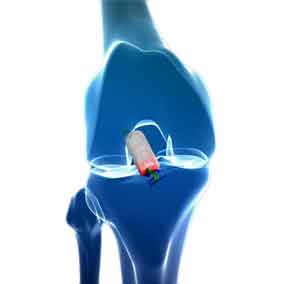
Instead of reconstructing the ACL utilizing a graft, the BEAR technique involves utilizing a medical device called BEAR Implant to bridge the gap between the torn ACL ends. The BEAR Implant is a resorbable implant (meaning it is gradually absorbed by the body) that is made from purified bovine (cow) collagen and is secured via sutures to bridge the gap between the torn ends of a patient’s ACL. The patient’s own blood is injected into the implant during the surgical implantation procedure with the aim of forming a device-protected clot that stimulates the body’s healing process. Within about 8 weeks of the BEAR implant procedure, it is absorbed and replaced by the body’s own tissue. An advantage of utilizing the BEAR Implant is that your surgeon does not need to obtain any graft tissue from another section of your body.
What is ACL?
The anterior cruciate ligament is one of the major stabilizing ligaments in the knee. It is a strong rope-like structure located in the center of the knee, running from the femur (thighbone) to the tibia (shinbone). The ACL is one of the four major ligaments of the knee that connects the femur to the tibia and helps stabilize your knee joint. It prevents excessive forward movement of the tibia in relation to the femur as well as limits rotational movements of the knee. When this ligament tears, unfortunately, it does not heal on its own and often leads to the feeling of instability in the knee, requiring reconstruction to correct the abnormality.
What are the Indications for the BEAR Implant for ACL Reconstruction?
ACL reconstruction surgery with a BEAR implant is indicated for skeletally mature patients of at least 14 years of age with a complete ACL tear, as confirmed by MRI. Patients should have an ACL stump connected to the tibia to enable restoration of the ACL and the implantation should be done within 50 days from the original ACL injury. The BEAR implant has been found to be effective across a wide range of tear types (type 1 through type 4).
An ACL tear or injury is a sports-related injury that occurs when the knee is forcefully twisted or hyper-extended. An ACL tear usually occurs with an abrupt directional change with the foot fixed on the ground or when the deceleration force crosses the knee. Changing direction rapidly, stopping suddenly, slowing down suddenly while running, landing from a jump incorrectly, and direct contact or collision, such as a football tackle can also result in injury to the ACL.
What is the Procedure for the BEAR Implant for ACL Reconstruction?
ACL reconstruction surgery with a BEAR implant is usually performed under general anesthesia in a minimally invasive arthroscopic technique. In general, the procedure involves the following steps:
- Your surgeon will make two to three small cuts, about 1/4-inch-long, around your knee.
- An arthroscope is inserted into the knee joint through one of the incisions.
- An arthroscope is a thin tubular instrument with a camera, light, and a magnifying lens attached at the end that is connected to an external monitor and enables your surgeon to view the inside of the knee joint.
- Along with the arthroscope, a sterile solution is pumped into the joint to expand it, enabling your surgeon to have a clear view and space to work inside the joint.
- Miniature surgical instruments are passed through the other incisions and the BEAR implant is placed in the space between the two ACL ends. The BEAR implant serves as a bridge to help the ends of the torn ACL heal together while maintaining the ACL's original attachments to the knee joints.
- The patient’s own blood is then added to the BEAR implant to activate clot formation. This eventually acts as a bridging structure that supports cellular migration and proliferation.
- Finally, the BEAR implant is secured by stitching the torn ACL ends onto it.
- Within 8 weeks of implantation, the BEAR implant device will be absorbed by the body and replaced by new native cells and tissues that will later become the new ligament.
- After confirming satisfactory reconstruction, the scope and the instruments are withdrawn, and the incisions are sutured and bandaged.
What is the Postoperative Care Involved in the BEAR Implant for ACL Reconstruction?
In general, postoperative care instructions and recovery after ACL reconstruction surgery with the BEAR implant will involve the following:
- You will be transferred to the recovery area where your nurse will closely observe you for any allergic or anesthetic reactions and monitor your vital signs as you recover.
- You may notice pain, swelling, and discomfort in the knee area. Pain and anti-inflammatory medications are provided as needed to keep you comfortable.
- You are advised to keep your leg elevated while resting to prevent swelling and pain.
- You will be given assistive devices such as crutches with instructions on restricted weight-bearing for a specified period of time. You are encouraged to walk with assistance as frequently as possible to prevent blood clots.
- Instructions on surgical site care and bathing will be provided to keep the wound clean and dry.
- Refrain from strenuous activities for the first few months and lifting heavy weights for at least 6 months. A gradual increase in activities is recommended.
- An individualized physical therapy protocol will be designed to help strengthen the knee muscles and optimize knee function.
- You should be able to resume your normal daily activities in a month or two, but with certain activity restrictions. Full recovery and return to sports usually take about 9 to 12 months.
- You may return to your work in about 6 weeks if your job is not too physically demanding. Those with physically demanding jobs will require a longer recovery period.
- Periodic follow-up appointments will be scheduled to monitor your progress.
What are the Benefits of the BEAR Implant for ACL Reconstruction?
Some of the benefits of the BEAR implant ACL reconstruction over traditional ACL reconstruction with a graft include:
- No need for graft tissue for reconstruction
- Prevents potential autograft/allograft tissue complications
- Reduced likelihood of post-traumatic osteoarthritis
- Higher-level hamstring strength
- Higher-level knee function scores
- Superior return to sports index
- Restores native ACL and function
- Minimally invasive compared to traditional ACL reconstruction surgery
- Easy revision surgery compared to a traditional revised ACL reconstruction
- Better overall functional outcome
What are the Risks and Complications of the BEAR Implant for ACL Reconstruction?
ACL reconstruction surgery with a BEAR implant is a relatively safe procedure; however, as with any surgery, some risks and complications may occur, such as the following:
- Infection
- Bleeding
- Knee pain
- Allergic/anesthetic reactions
- Re-tear or reinjury
- Blood clot or deep vein thrombosis
- Damage to adjacent soft tissue structures
- Stiffness or limited range of motion
For more information about our services or to schedule an appointment, call us at / or request an appointment online. We’ll respond to you as soon as possible.